Technology itself does not create new value. Public value appears only when we are willing to improve our processes and build a supportive legal framework to carry the change. If there is a real need, and a real readiness to meet it, then we can enter an AI era in which agents help citizens with everyday actions and with communicating with their government.
This is the starting point for agentic government. Everything below is downstream of it.
A capable model does not fix a fragmented service. An API does not create legal authority. A digital identity does not prove that a particular action is permitted. Automation applied to an unclear process usually makes the confusion faster, less visible, and harder to challenge.
The correct sequence is therefore not model → chatbot → integration → policy. It is:
need → process redesign → legal authority and safeguards → operational readiness → bounded agent → measurable outcomes
This is a design position, not a quotation from any regulation. It is consistent with the evidence. The OECD names institutional arrangements, coordination, data governance, common building blocks, user-centred design, and outcome measurement as the conditions for sustainable digital-government transformation. Estonia’s own Digital Agenda is unusually direct: wider use of AI in government “requires changes in work processes and information systems,” while competence, legal, and algorithmic-trustworthiness gaps remain open.
The question is not whether an AI agent can call a government API. It is whether the institution can justify, control, explain, and correct the resulting action.
In August I argued that we have the tool layer but lack the authorization layer. This post is the blueprint for that layer: mandates separated from access tokens, the citizen approval path enforced, key use isolated from the model, and revocation strictly propagated to derived grants.
Start with the service failure, not the model
Before selecting an agent framework, a public institution should name the failure it is trying to correct. Citizens do not need “AI” as a product. They may need to understand which benefit they qualify for, avoid entering the same information repeatedly, prepare an application, coordinate a life event across agencies, or get a clear answer without first learning the organisational structure of the state.
That distinction changes procurement and architecture alike. Measure the project against service outcomes: completion rate, processing time, avoidable contacts, accessibility, error and appeal rates, staff workload, unequal outcomes. Model accuracy and automation percentage are engineering measures. They are not, by themselves, measures of public value.
Three lanes of agent assistance need different rules.
| Lane | Agent role | Decision boundary |
|---|---|---|
| Information and navigation | Explains services, finds authoritative information, directs the citizen to the right channel. | The agent does not alter rights, obligations, or authoritative records. |
| Assisted casework | Collects information, prepares drafts, checks completeness, coordinates steps. | A responsible person or deterministic service rule remains the decision-maker. |
| Consequential action | Submits, modifies, pays, signs, or otherwise exercises the citizen’s legal or financial intent. | Explicit authority, stronger evidence, current policy, confirmation where required, and a remedy path are mandatory. |
Estonia’s published description of Bürokratt fits the first lane: it helps citizens find public-service information and routes them to a person when it gets stuck. That is a disciplined foundation. It should not be misread as proof that autonomous software already exercises administrative authority.
Agentic government is a delegation problem
Once an agent can do more than explain, the central technical problem is not conversation. It is delegation. Six questions have to be answerable for every action:
- Who is the legal principal? The person or organisation on whose behalf the action occurs. A legally recognised representative acts for that principal.
- What may be delegated? Exact actions, resources, services, limits, purposes, time periods.
- Which logical agent may act? The registered software actor and its responsible operator.
- Which running workload is making this request? The deployed process, device, or protected client using a particular key.
- Which service makes the final decision? The authority that owns the resource, workflow, and current policy.
- What evidence remains afterwards? The actor chain, decision basis, confirmation, committed result, receipt.
These are different objects with different owners and lifecycles. Collapsing them into one bearer token creates a standing master key. A safer architecture keeps them separate.
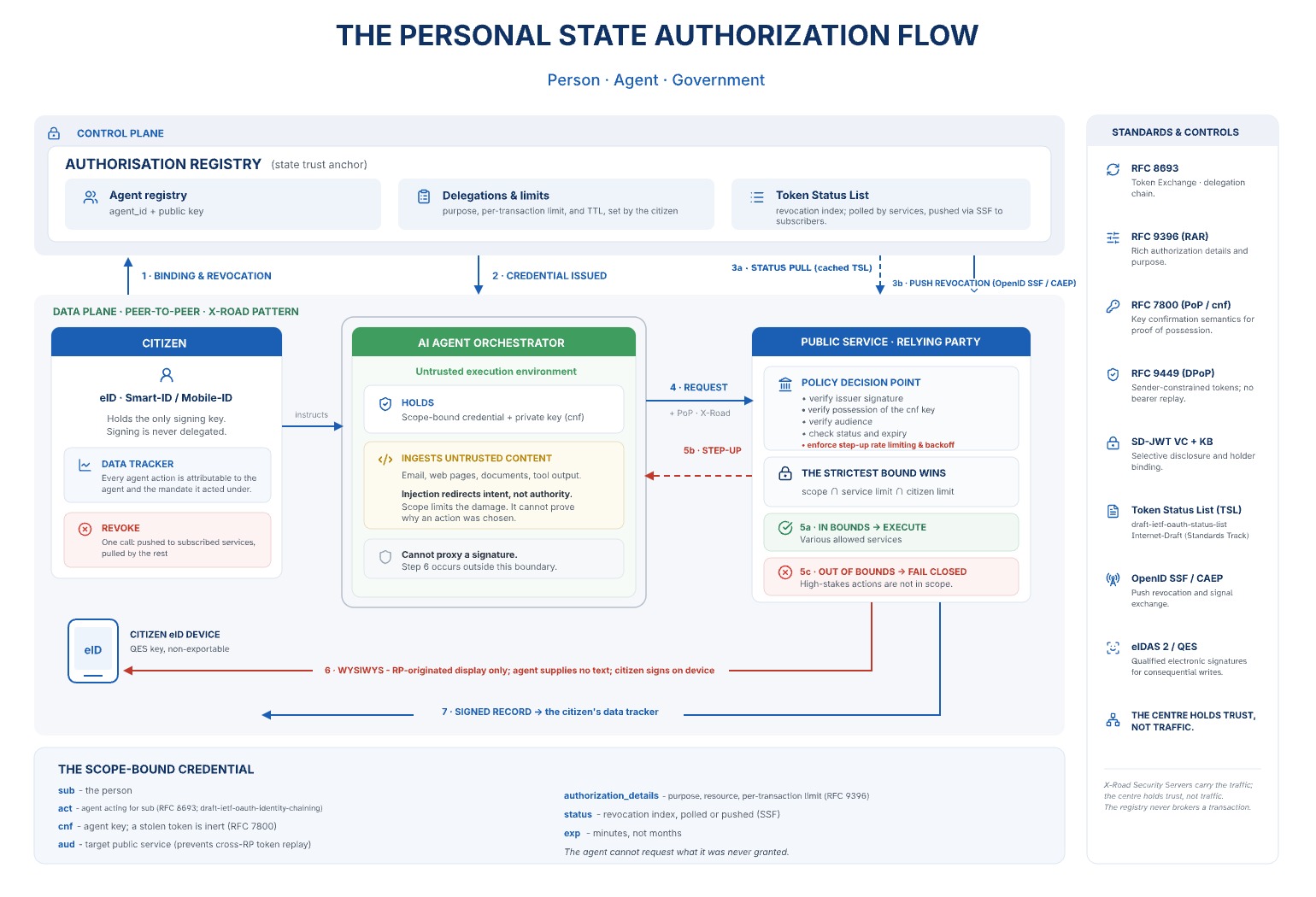
Figure 1. The personal-state authorization flow. A control plane (the authorization registry: agent registry, delegations and limits, token status list) sits above a peer-to-peer data plane in the X-Road pattern. The citizen binds and revokes; the registry issues a scope-bound credential; the agent presents it with proof of possession; the public service verifies and decides; consequential writes step up to the citizen’s eID device; the signed record flows back to the citizen’s data tracker. This is an architectural proposal, not a description of a current national deployment. Note: The “exp - minutes, not months” label in the credential box refers to derived execution tokens, while the underlying mandate itself remains durable. Additionally, while the diagram simplifies the agent environment into a single box, the private key is held securely in a protected client outside the untrusted orchestrator.
Three properties of the diagram carry most of the weight.
The strictest bound wins. The effective authority for any action is scope ∩ service limit ∩ citizen limit. The agent cannot request what it was never granted; the service cannot be talked into more than its own policy allows; the citizen’s per-transaction and TTL limits cap both.
Injection redirects intent, not authority. The orchestrator is an untrusted execution environment. It ingests email, web pages, documents, tool output. A successful injection can change which in-scope action the agent picks; it cannot widen the scope, because scope lives in a signed credential the agent cannot mint and the service verifies independently. The agent also cannot prove why it chose an action, which is exactly why Figure 1’s step 6 (step-up confirmation) exists.
Signing is never delegated. The agent cannot proxy a signature. Figure 1’s step 6 happens outside the agent boundary: the relying party renders the transaction, the citizen signs on a device holding a non-exportable QES key, and the agent supplies no text to that screen.
The centre holds trust, not traffic
In an Estonian context this resembles a property of X-Road: the central server distributes membership and security-policy configuration, while security servers mediate the actual requests and responses. The analogy is architectural, not literal. A future national trust plane could publish trusted issuers, mandate status, and operator information without ever seeing the contents of an ordinary citizen-service transaction. The registry never brokers a transaction.
“Outside the data path” does not mean “never contacted.” Credential issuance, periodic status distribution, and exceptional identity resolution still touch the control plane. What the baseline forbids is synchronous consultation of a national service on every ordinary action.
Two independent trust chains then meet at the receiving public service:
- the mandate chain, which represents what the person has authorized; and
- the workload-identity chain, which identifies the software instance or managed workload presenting the request.
Neither is sufficient alone. A valid mandate presented by the wrong workload must fail. A correctly attested workload without authority from the citizen must also fail.
Separate mandates, presentations, and access tokens
A durable mandate, a portable credential, a fresh presentation, an access token, and a downstream action grant are five different things.
| Object | Purpose | Typical lifetime | Primary owner |
|---|---|---|---|
| Mandate record | Authoritative, revocable definition of delegated authority. | Use-case-specific | Mandate issuer or registry |
| Mandate credential | Signed, portable representation of selected mandate facts. | Bounded, longer than a token | Trusted issuer |
| Presentation | Fresh proof revealing required facts and, where required, control of the holder key. | One transaction | Citizen-controlled holder |
| Service access token | Permission to call one service within a narrow scope and audience. | Minutes | Service authorization server |
| Downstream action grant | Further attenuated authority for one internal actor, tool, or command. | Seconds or one operation | Delegating service |
The separation matters for revocation, privacy, and audit. Revoking a mandate should invalidate dependent grants within a defined bound. Expiring one service token should not erase the durable mandate. A fresh presentation should not silently become an unlimited execution credential. And “minutes, not months” applies to execution tokens, not universally to the mandate; a tax-declaration mandate that legitimately spans a month is not a bug.
Semantically, a mandate looks like this:
{
  "delegation_id": "urn:example:delegation:7d2…",
  "principal_ref": "pairwise-subject-for-this-service",
  "agent_id": "urn:example:agent:personal-assistant-42",
  "operator_id": "urn:example:operator:acme",
  "allowed_services": ["urn:service:tax-filing"],
  "authorization_details": [
    {
      "type": "urn:gov:action:submit-declaration",
      "resource": "urn:tax-year:2026",
      "actions": ["prepare", "submit"]
    }
  ],
  "constraints": {
    "purpose": "annual-tax-declaration",
    "max_submissions": 1,
    "delegation_depth": 0
  },
  "valid_from": "2026-09-05T06:00:00Z",
  "valid_until": "2026-10-05T06:00:00Z",
  "status": "https://issuer.example/status/…",
  "holder_binding": "public-key-reference"
}
This is a semantic example, not a wire schema. The real profile must fix claim names, mandatory disclosures, versioning, status behaviour, audience rules, and the relationship between a citizen-held credential and an agent workload. Two binding rules are non-negotiable: the presentation audience and nonce bind the proof to a verifier, but setting an audience cannot create service authority; and if the access-token DPoP key differs from the credential holder key, the issuer must see proofs linking both keys in the same authenticated transaction. A matching string supplied by the agent is not a binding.
What the standards can prove, and what they cannot
A credible implementation reuses standards. But standards must not be assigned powers they do not have. As of 5 September 2026, a plausible baseline:
| Building block | Role | Important limit |
|---|---|---|
| SD-JWT, RFC 9901 | Issuer-signed selective disclosure with optional holder-key binding. | Selective disclosure is not anonymity, authorization, or automatic revocation. |
| SD-JWT VC, draft 19 | Profiles SD-JWT as a verifiable credential format. | Still an Internet-Draft; pin a version. |
| OpenID4VP 1.0 | Carries verifier-requested presentations; defines verifier-side validation. | Transports evidence; is not an authorization engine. |
| SPIFFE/SPIRE | Authenticates a workload inside an operator-controlled trust domain. | Does not prove citizen intent, legal authority, or correct model behaviour. |
| DPoP, RFC 9449 | Sender-constrains an OAuth token to a key and request proof. | Not authorization; useless when both token and key are compromised. |
| RAR, RFC 9396 | Carries structured authorization_details: actions, locations, data types, resources. |
Government action semantics and approval rules remain profile-specific. |
| Token Exchange, RFC 8693 | Exchanges evidence for a new token; represents subject/actor relationships. | Does not automatically attenuate authority or link parent-child revocation. |
| Token Status List, draft 21 | Signed status a verifier can retrieve and validate. | Still an Internet-Draft; freshness and fail-closed rules are deployment choices. |
RFC 9901’s key-binding proof binds a presentation to an intended verifier and transaction via aud, nonce, iat, and sd_hash. The verifier must decide in advance that key binding is required and reject presentations without it. OpenID4VP puts the same burden on the verifier: integrity, query satisfaction, holder binding, replay controls, and its own trust policy.
Those checks prove limited propositions. They show that an issuer signed particular claims, that selected claims were disclosed without modification, and that the presenter controlled the relevant key for this transaction. They do not prove that the citizen understood every consequence, that the agent has general legal capacity, or that a requested action is lawful.
SPIFFE proves something different again. A SPIFFE ID identifies a workload within a trust domain and may be shared by replicas, so it is not inherently a globally unique process identifier. Never put personal identifiers or business mandates in an SVID. The operator is responsible for the workload; the mandate issuer is responsible for the citizen’s delegated authority; the service verifies both.
The end-to-end flow, in ten steps
- Authenticate the principal with an accepted eID. If the person represents an organisation, verify that representation from an authoritative source and record when it was checked.
- Register the agent relationship: bind the logical agent, responsible operator, and allowed holder key. Show the citizen which services and actions are being requested, in a trusted interface.
- Create the mandate: exact audiences, actions, resources, limits, purpose code, validity, maximum delegation depth. Verify the principal can legally grant it.
- Issue the mandate credential with only the necessary claims and an authenticated status reference. Workload attestation stays a separate operator responsibility.
- Present evidence to the service: the holder reveals required claims and produces a fresh, verifier-bound proof. The protected agent client also presents workload or device evidence.
- Verify and bind: issuer trust, schema version, signatures, disclosures, time bounds, status freshness, audience, nonce, replay protection, and the agent–operator–workload–key binding.
- Issue narrow service authority: if repeated calls are needed, a service authorization server issues a short-lived, audience-restricted, sender-constrained access token, as the OAuth Security BCP recommends. This token does not freeze local business permission.
- Decide the concrete action: the service combines verified mandate constraints with current local facts: ownership, eligibility, workflow state, tenant, cumulative limits, policy.
- Confirm when required: freeze the exact transaction, display authoritative details through a trusted channel, receive bound approval, recheck policy and state before committing.
- Execute and return evidence: a deterministic command boundary commits the action idempotently, records the actor and authority chain, and returns a citizen-visible receipt.
The model is not trusted to perform steps 6, 8, 9, or 10 by itself. It may plan, explain, retrieve, and prepare. Trusted code verifies evidence. The service makes the authorization decision. A deterministic command boundary performs the side effect. Issuance and presentation need not recur on every API call, but enforcement, status freshness, and resource-state checks apply at every protected operation, and again when a queued operation is dispatched.
The public service stays the enforcement boundary
A government service cannot outsource its final authorization decision to the citizen’s agent, to a model gateway, or to a national registry.
A policy enforcement point sits at the resource API or command broker. A policy decision point evaluates verified context and authoritative service state. Its result is one of three explicit outcomes:
- permit — the action is within current authority;
- confirmation_required — the action is eligible but needs a specified human approval;
- deny — the evidence, authority, policy, or state does not permit it.
Stronger authentication cannot repair missing authority. If the citizen never granted the action, asking for another PIN does not make it valid. A new or expanded mandate is a separate process.
For every protected operation the service checks:
| Check | Enforcement requirement |
|---|---|
| Action and resource | Map the external action vocabulary to a local permission. Validate tenant, object, arguments, resource version. Reject unknown authority-bearing fields. |
| Cumulative limits | Enforce count, value, currency, period, and concurrency atomically. Several individually valid actions must not exceed a shared limit. |
| Purpose | Apply machine-checkable rules bound to an approved purpose code. A model-generated explanation is not proof of purpose. |
| Consistency | Recheck sensitive state at commit, or require a versioned authorization precondition. |
| Retries | Bind an idempotency key to principal, mandate, action, and payload digest. Reuse with a changed payload must fail. |
| Derived authority | Every downstream grant narrows audience, action, resource, limits, lifetime, and delegation depth. |
RAR carries structured authorization data, but the authorization server owns the meaning of each type and the API designer owns the allowed fields. RFC 8693 explicitly says exchange is a one-time event with no tight linkage between input and output tokens. Monotonic attenuation, every child grant strictly no broader than its parent, is therefore an architectural rule the implementation must enforce, not a property the standards give you. A shared cross-service spending ceiling likewise needs coordinated accounting or preallocated quotas; independently cached tokens cannot enforce a shared consumable budget.
Design for prompt injection as an authorization problem
An agent consumes untrusted content: websites, email, documents, messages, tool output. Prompt injection must be assumed, not treated as an exceptional model failure.
The model or planner runs outside the protected credential boundary. A hardened agent client controls credential storage, token acquisition, proof generation, request construction, and access to side-effecting tools. The model proposes a structured action; trusted code validates it against a fixed schema and the active mandate.
A non-exportable key is still a signing oracle if an attacker can invoke it without constraint. The protected client reduces exposure; the public service remains the final enforcement boundary. Host or signing-component compromise is a different threat from prompt injection and needs operator containment, not a better prompt.
| Threat | Required response |
|---|---|
| Prompt injection / malicious tool output | Treat content as data; validate structured actions; restrict egress; enforce limits outside the model. |
| Stolen token or proof replay | Require key proof, narrow audience, freshness, replay controls. |
| Wrong agent with valid evidence | Verify logical agent, operator, workload/device, and holder key together. |
| Payload substitution after approval | Bind approval to the exact transaction and resource version; recheck at commit. |
| Split or concurrent transactions | Atomic counters, reservations, idempotency, cumulative bounds. |
| Stale policy or revoked parent | Invalidate descendants; check current policy and bounded status at each effect. |
| Issuer or operator compromise | Issuer/domain quarantine, key rotation, isolated trust domains. |
| Malicious metadata or key URL | Pinned trust roots and approved resolution paths; reject token-directed arbitrary fetches. |
Even perfect cryptography cannot stop an agent from choosing a harmful action that still sits inside an overly broad mandate. The strongest defence remains narrow scope, current business validation, and transaction confirmation for consequences the citizen should review.
Confirmation must bind the exact transaction
“What you see is what you sign” is an end-to-end property. It is not guaranteed by naming eID, Mobile-ID, Smart-ID, or a wallet. A PIN screen alone does not prove the full transaction was displayed.
For consequential actions, confirmation includes the action, service, principal, mandate version, resource and its version, material values, payload digest, nonce, and expiry. The service, not the agent, renders the authoritative transaction details. Agent-generated explanatory text cannot substitute for them. A changed payload invalidates the approval. Approval is consumed once and rechecked atomically at commit; delayed callbacks and duplicate approvals must not repeat the effect. JCS (RFC 8785) is a usable canonicalization building block, not a transaction-signing protocol.
A receipt is not a signature. It is evidence produced by the service that a request was evaluated and a result committed. Whether an act required ordinary authentication, explicit approval, multiple approvers, or a qualified electronic signature is a legal and service-policy question. eIDAS gives a qualified electronic signature the legal effect of a handwritten signature; a DPoP proof, workload SVID, or mandate token is not one. This architecture does not impose QES on every consequential write; it makes the service owner say which class each action belongs to.
Revocation needs a measurable contract
Revocation does not undo a completed transaction. It prevents future use once the relevant verifier has accepted fresh status. Checking the mandate only at token issuance is insufficient; dependent service tokens and internal grants must be invalidated.
A credible profile defines a maximum end-to-end revocation window:
publication delay + delivery or refresh delay + verifier application delay + clock allowance
A verified push event (OpenID SSF / CAEP) can shorten it, but does not prove every relying party applied the update. Proposed pilot defaults, subject to service approval:
| Parameter | Starting value | Interpretation |
|---|---|---|
| API access token lifetime | 5 min | Never later than mandate expiry; revocation still enforced during validity. |
| Internal action grant lifetime | 60 s | Single purpose and audience; never later than its parent. |
| Proof / approval age | 60 s / 120 s | Single-use nonce or challenge; clock skew bound 30 s. |
| Status publication / refresh | 30 s / 30 s | Target intervals, not a statement of current national capability. |
| Maximum signed status age | 120 s | Fail closed for protected writes when exceeded. |
Failure behaviour must be explicit. While a 120-second fail-closed bound is an aggressive target for a pilot, rolling it out nationally without resilient CRL fallbacks would create a single point of failure (a short CDN hiccup would halt all protected writes). However, the principle remains: if a status snapshot is older than the permitted signed age for a given service tier, a protected write fails closed. Fetching the same stale snapshot again does not make it fresh. If a command times out after dispatch and its result is uncertain, the system returns an indeterminate result with the original operation identifier and reconciles it, rather than issuing a second command blindly.
Law supplies authority; standards carry evidence
Technical delegation must sit inside the governing legal process.
Under the GDPR, a government agent processing personal data still needs a lawful basis, purpose limitation, data minimisation, security, and data protection by design. A DPIA is required where processing is likely to create high risk. Article 22 restricts decisions based solely on automated processing that produce legal or similarly significant effects. The GDPR does not ban automation, and a DPIA does not create substantive public authority.
The EU AI Act is use-case and risk based. A citizen-facing agent is not automatically high-risk because government uses it; classification depends on intended purpose and actual influence. Separate Article 50 transparency obligations may apply independently of high-risk classification. Regulation (EU) 2026/1744 moved the Chapter III high-risk obligations for Article 6(2) / Annex III systems to 2 December 2027, and the Article 6(1) / Annex I obligations to 2 August 2028. Existing GDPR, administrative-law, accessibility, cybersecurity, and sector duties apply throughout the transition.
For Estonia, the Administrative Procedure Act draws the boundary. It is crucial to distinguish between a citizen’s representative and an administrative authority. When software prepares or transmits an application, the legal actor remains the citizen or a legally recognized representative. The software is the controlled technical means through which that actor’s authenticated and bounded instruction is carried. However, when a government service uses an algorithm to grant or deny a benefit, that is an automated administrative act (automaatne haldusakt) which must come from a competent authority, comply with applicable law, state its factual and legal reasoning, and say how it may be challenged. A model output is not, merely because it is digitally signed or logged, a lawful administrative act.
The division of labour:
| Source | What it can establish | What it cannot establish alone |
|---|---|---|
| Law and administrative procedure | Competence, delegability, legal effect, safeguards, reasons, remedies. | Cryptographic identity or secure protocol execution. |
| Credential issuer | Signed claims about a mandate or attribute. | Whether the receiving service should permit the action. |
| Holder-bound presentation | Control of a presentation key for a specific verifier transaction. | General informed consent or unlimited future authority. |
| Workload identity | Which attested software workload made the request. | Citizen intent or legal power. |
| Authorization service | A narrow technical capability based on evaluated evidence. | Final resource-state truth at every target service. |
| Public service | Current authorization and a committed result under its own rules. | Immunity from error, review, correction, or appeal. |
Privacy sits in the same table. Use service-scoped principal references by default; do not expose an isikukood, a reusable agent identifier, or a common holder key to every service. Selective disclosure is not unlinkability: reusing the same credential, key, status reference, or distinctive claims enables correlation even with pairwise subjects. The citizen’s data tracker should retrieve protected receipts from services, not become a second central log of payloads.
A realistic adoption path
Agentic government should not begin by automating the most consequential decision available. It should earn authority through staged evidence.
- Stage 1 — navigation and preparation. High-volume, low-consequence services. Measure whether citizens reach the right service, complete tasks, and can still reach a person.
- Stage 2 — narrow reversible actions. Retrieve a protected document, update a low-risk preference, save a draft. Introduce mandate profiles, holder binding, workload identity, service-local enforcement, receipts, revocation testing.
- Stage 3 — bounded submissions. Clearly defined filings with exact-transaction confirmation, deterministic validation, idempotent execution, and a documented correction process.
- Stage 4 — consequential workflows. Benefits, payments, licences, and other rights-affecting processes, only after task-specific legal analysis, DPIA, AI Act classification, security validation, accessibility testing, independent oversight, and operational appeal handling.
A pilot must test denial and failure, not only the happy path. Minimum acceptance scenarios:
| Scenario | Required observable result |
|---|---|
| Valid, in-scope request | One permitted effect and a receipt tied to the correct actor chain. |
| Wrong agent / audience / missing constraint | Denial before resource access or side effects. |
| Stolen token without the bound key | Rejected; no downgrade to bearer acceptance. |
| Replayed proof, approval, or command | No duplicate effect; valid retries return the original result. |
| Changed payload or resource after approval | Reject or require renewed confirmation. |
| Parent revoked while child token lives | Dependent action denied within the measured revocation contract. |
| Status outage or rollback | No protected writes beyond the signed freshness bound. |
| Parallel actions crossing a total limit | Atomic enforcement; accepted total stays inside the allowance. |
| Local policy change / domain quarantine | Enforcement reflects the change within its declared consistency bound. |
| Prompt injection and queued execution | External content cannot widen authority; queued effects recheck authorization. |
Keep the domain model independent of any particular national registry. A local mandate adapter can provide the same verified context as a future national issuer; delegation_id is an opaque reference, not a foreign key whose reassignment completes federation. Swap the trust adapters against a second issuer before adding a live national integration. Only reproducible runtime evidence justifies moving to the next stage.
The agent is not the authority
The promise of agentic government is not a state run by autonomous models. It is a state in which people receive practical, personalised help without surrendering control or learning the internal structure of public administration.
That future is technically plausible. We have building blocks for selective disclosure, verifiable presentations, workload identity, sender-constrained tokens, structured authorization, status distribution, and distributed service exchange. But a catalogue of standards is not an interoperability profile, and cryptographic proof is not permission.
The durable architecture is institutional as much as technical:
- the person delegates a precisely bounded mandate;
- the agent acts through an authenticated workload and protected client;
- the service enforces current law, policy, limits, and resource state;
- the person confirms the transactions that require personal judgment;
- the system records what was requested, allowed, committed, and why;
- the institution remains accountable for correction, review, and appeal.
So the first question stays the most important one: is there a real public need, and are we willing to change the process and legal framework needed to meet it?
If the answer is no, an AI agent will add another interface to the same problem. If the answer is yes, and the institution is ready, then agents can become a meaningful new layer between citizens and government: not a blank cheque, not a shadow official, but a constrained and accountable instrument for making public services easier to use.
References
- OECD — Governing with Artificial Intelligence: how AI is accelerating the digital government journey
- Estonia’s Digital Agenda 2030 (Digiühiskonna arengukava)
- RIA — Bürokratt
- X-Road Architecture
- Regulation (EU) 2016/679 (GDPR), Articles 5, 22, 35
- Regulation (EU) 2024/1689 (AI Act), consolidated
- Regulation (EU) 2026/1744 — AI Act high-risk timetable
- Estonian Administrative Procedure Act (Haldusmenetluse seadus), consolidated text in force from 01.01.2024
- Regulation (EU) 910/2014 (eIDAS), consolidated, Article 25
- RFC 9901 — Selective Disclosure for JWTs (SD-JWT)
- draft-ietf-oauth-sd-jwt-vc-19 — SD-JWT Verifiable Credentials
- OpenID for Verifiable Presentations 1.0
- OpenID Federation 1.0
- SPIFFE Concepts · SPIRE Concepts
- RFC 7800 — Proof-of-Possession Key Semantics for JWTs
- RFC 9449 — OAuth 2.0 Demonstrating Proof-of-Possession (DPoP)
- RFC 9700 — OAuth 2.0 Security Best Current Practice
- RFC 9396 — OAuth 2.0 Rich Authorization Requests
- RFC 8693 — OAuth 2.0 Token Exchange
- RFC 8785 — JSON Canonicalization Scheme
- draft-ietf-oauth-status-list-21 — Token Status List
- OpenID Shared Signals Framework 1.0 · OpenID CAEP 1.0
- OpenFGA — token claims as contextual tuples